The ancient stones of Kashi whisper stories that have survived for thousands of years. In this part of the Varanasi Revolutionary FAQ, we answer questions 276 to 300 about the mystical legends and folklore of Varanasi.
Unveiling the Ancient Legends of Kashi
276. Why is it said that Varanasi rests on Lord Shiva’s Trishul (Trident)?
According to ancient Kashi legends, the city does not rest on the earth but is supported by the trident of Lord Shiva. This symbolizes that Varanasi is a spiritual dimension protected from the worldly cycles of destruction.
277. What is the mystery behind the ‘Eternal Flame’ at Manikarnika Ghat?
Local Kashi lore says that the funeral fire at Manikarnika Ghat in Varanasi has never been extinguished for thousands of years. It is believed that Lord Shiva himself recites the ‘Taraka Mantra’ in the ears of the departed in Varanasi.
278. Is there a story about the ‘Tilbhandeshwar’ Mahadev in Varanasi?
Yes, the Tilbhandeshwar temple in Kashi is famous for a self-manifested Shivalinga that is said to grow by the size of a sesame seed every year. It is one of the most fascinating living mysteries for travelers in Varanasi.
279. Who is the ‘Dhanvantari’ and his connection to Varanasi?
Lord Dhanvantari, the god of Ayurveda, is believed to have incarnated as the King of Kashi. This legend is why Varanasi has been the world center for traditional healing and Vedic medicine for centuries.
280. What is the legend of the ‘Leaning Temple’ of Varanasi?
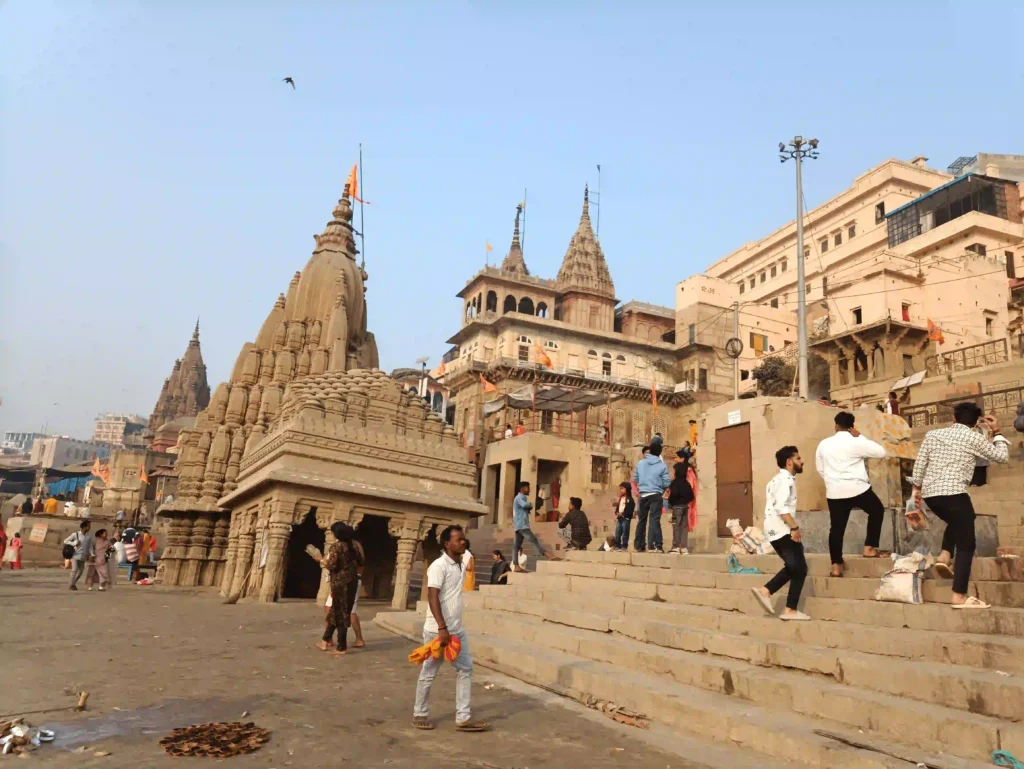
The Ratneshwar Mahadev temple at Scindia Ghat in Varanasi leans at an angle even greater than the Tower of Pisa. Local Kashi myths say it was cursed by a mother, but architecturally, it remains a marvel of ancient Varanasi.
281. Why is the ‘Kashi Vishwanath Temple’ rebuilt so many times?
Historical records and Kashi legends tell of the temple being destroyed and rebuilt multiple times over a thousand years. Each time, the ‘Jyotirlinga’ was hidden in the Gyan Vapi well of Varanasi to protect it from invaders.
Folklore & Cultural Myths of Varanasi
282. Is it true that dying in Varanasi grants immediate ‘Moksha’ (Liberation)?
Yes, a core belief in Kashi is that anyone who dies within the sacred boundaries of Varanasi is freed from the cycle of rebirth. This profound spiritual promise draws people from all over the world to Varanasi.
283. What is the legend of the ‘Flying Hanuman’ in Kashi?
The Sankat Mochan Temple in Varanasi is said to be established by Saint Tulsidas himself after he had a vision of Hanuman. The legend says the deity protects Varanasi from all planetary troubles and evil spirits.
284. Why are the ‘Narrow Lanes’ of Varanasi considered sacred?
Local storytellers in Kashi believe that every lane of Varanasi represents a different nerve or ‘Nadi’ in the spiritual body of the city. Walking through these Varanasi lanes is considered a form of meditation in itself.
285. What is the story of the ‘Ganges’ descending to Varanasi?
Mythology says the river Ganga descended to Earth from Lord Shiva’s hair to purify the ancestors of King Bhagirath. Varanasi is where the river turns ‘Uttravahini’ (north-flowing), making it the most sacred spot in Kashi.
286. Is there a legend about ‘Baba Keenaram’ in Varanasi?
Baba Keenaram was a legendary 17th-century saint of the Aghori tradition in Kashi. His ‘Dhuni’ (sacred fire) at Krim Kund in Varanasi is still active and is believed to have miraculous healing powers for travelers.
287. Why is ‘Varanasi’ called the City of Light (Kashi)?
The name Kashi comes from the Sanskrit root ‘Kas’, meaning to shine. Ancient legends say that Varanasi is where the supreme light of consciousness first touched the Earth, earning it the title of the ‘City of Light’.
288. What is the ‘Kashi Panchkroshi Yatra’ mystery?
This 80 km pilgrimage around the boundary of Varanasi is said to be a journey through the entire universe. Completing this walk is believed to provide the same spiritual merit as visiting every sacred site in India from Varanasi.
289. Does the ‘Dom Raja’ really have a royal lineage in Kashi?
Yes, the Dom Raja family in Varanasi is considered the keeper of the sacred fire. Legends say they were granted this eternal right by King Harishchandra, and they remain the most respected lineage in the spiritual sociology of Varanasi.
290. What is the myth of ‘Akash Deep’ during Kartik month in Varanasi?
During the month of Kartik, lanterns are hung on tall bamboo poles over the Varanasi ghats. It is believed these lights guide the souls of ancestors back to heaven from the sacred riverfront of Kashi.
291. Why are ‘Bulls’ given so much respect in the streets of Varanasi?
Bulls are considered the ‘Nandi’ or the vehicle of Lord Shiva. In Kashi, they roam freely and are fed by locals, symbolizing the living presence of divine energy in the daily life of Varanasi.
292. Is there a ‘Hidden Tunnel’ from Varanasi to Sarnath?
Many local myths in Kashi suggest there are ancient underground tunnels connecting the main temples of Varanasi to the Buddhist ruins of Sarnath. While not scientifically proven, these stories add to the mystery of Varanasi.
293. What is the story of ‘Annapurna Devi’ feeding Lord Shiva in Kashi?
A famous Kashi legend says that even Lord Shiva had to beg for food from Goddess Annapurna in Varanasi. This is why it is believed that no one ever goes hungry in the sacred city of Varanasi.
294. Why is the ‘Sathwa’ (Honesty) of King Harishchandra famous in Varanasi?
King Harishchandra worked as a cremator at the Varanasi ghats to uphold his promise of truth. The Harishchandra Ghat in Kashi stands as a testament to his legendary sacrifice and the value of truth in Varanasi.
295. Is the ‘Gyan Vapi’ well in Varanasi really a source of wisdom?
‘Gyan Vapi’ translates to the ‘Well of Knowledge’. Kashi myths say that the water of this well in Varanasi is so sacred that drinking it provides instant spiritual enlightenment and deep wisdom.
296. What is the secret of the ‘Nine Durgas’ of Varanasi?
Varanasi houses nine ancient temples dedicated to the different forms of Goddess Durga. Visiting all nine during Navratri is a powerful Kashi tradition that is said to fulfill all worldly and spiritual desires in Varanasi.
297. Why is ‘Kashiraja’ (The King of Varanasi) called an incarnation of Shiva?
The people of Kashi traditionally view the Maharaja of Varanasi as the local representative of Lord Shiva. His presence during festivals like Ramlila is considered essential for the spiritual well-being of Varanasi.
298. What is the significance of the ‘Bhairavi’ energy in Varanasi?
Kashi is believed to be protected by eight Bhairavas (guards). Each guard temple in Varanasi ensures that only those with pure intentions can truly experience the deeper secrets of the sacred city of Kashi.
299. Is there a ‘Sun Temple’ legend in the city of Varanasi?
Ancient texts mention twelve Sun temples (Adityas) in Kashi. While many are hidden today, the legend of the ‘Lolark Kund’ in Varanasi remains as a reminder of the city’s ancient connection to Sun worship.
300. How does the ‘Sound of Kashi’ differ from other cities?
It is said that the ‘Om’ vibration is naturally audible in the silence of the Varanasi ghats at night. This mystical sound is what draws thousands of spiritual seekers to Kashi to experience the eternal pulse of Varanasi.
[Link: Click here for Part 13 – Questions 301 to 500 of the Revolutionary Varanasi FAQ]
Disclaimer: These legends and myths are part of the oral and scriptural tradition of Kashi. While they carry deep spiritual meaning, they should be viewed through the lens of faith and cultural heritage during your Varanasi visit [cite: 2026-01-31].