
The ancient lanes, ghats, temples and sacred traditions of Kashi preserve
stories that have been passed down for generations. In this part of the
Varanasi Revolutionary FAQ, we explore
Questions 276 to 300, focusing on the myths, legends,
beliefs and hidden stories associated with Varanasi.
Some of these accounts come from Hindu religious tradition, temple lore
and local oral history, while others have historical or architectural
dimensions. Where a story is a matter of faith or folklore, it is
presented as such rather than as a scientifically established fact.
Quick Answer: Varanasi’s legends are a mixture of
Hindu religious traditions, temple stories, local folklore, oral
traditions and documented history. This guide separates faith and
folklore from claims that can be historically or scientifically
established.
Ancient Legends and Sacred Traditions of Kashi
276. Why is it said that Varanasi rests on Lord Shiva’s Trishul?
According to a longstanding Kashi tradition, Varanasi is believed to rest
upon the Trishul (trident) of Lord Shiva rather than
being an ordinary earthly city. The idea reflects the sacred status of
Kashi in Hindu tradition, where the city is regarded as closely connected
with Shiva and protected from the ordinary cycles of creation and
destruction.
The Trishul is therefore best understood as a
religious and symbolic belief, representing divine
protection and the timeless spiritual identity of Kashi rather than a
literal geological claim.
277. What is the tradition behind the ‘Eternal Flame’ at Manikarnika Ghat?
Manikarnika Ghat is one of Varanasi’s most important cremation grounds
and is surrounded by powerful religious traditions concerning death,
liberation and the sacred presence of Shiva.
Local and devotional traditions often describe the cremation fire at
Manikarnika as eternal or continuously maintained. The
belief is closely connected with the spiritual importance of dying in
Kashi and the traditional association of Lord Shiva with liberation.
The exact historical continuity of an individual fire over thousands of
years is not something that can be independently established, so the
“eternal flame” is best understood primarily as a
sacred tradition and symbol of continuity.
278. What is the legend of Tilbhandeshwar Mahadev in Varanasi?
Tilbhandeshwar Mahadev is associated with a fascinating local tradition
surrounding a self-manifested form of Shiva. According to popular Kashi
lore, the Shivalinga is believed to increase in size gradually,
traditionally described as growing by approximately the size of a sesame
seed.
The story has become part of the living religious folklore of Varanasi
and illustrates how temple traditions, devotion and local storytelling
continue to shape the cultural identity of Kashi.
279. Who is Dhanvantari, and what is his connection to Varanasi?
Dhanvantari is revered in Hindu tradition as the divine
figure associated with Ayurveda and healing. Kashi also has a
long-standing association with learning, medicine, Sanskrit scholarship
and traditional knowledge.
Some traditions connect Dhanvantari with the ancient intellectual and
religious heritage of Kashi. These accounts are part of the religious
and cultural traditions surrounding the city rather than a straightforward
historical biography of a single identifiable ruler.
The connection is significant because it reflects Kashi’s wider
reputation as a historic centre of knowledge and learning.
280. What is the legend of the ‘Leaning Temple’ of Varanasi?
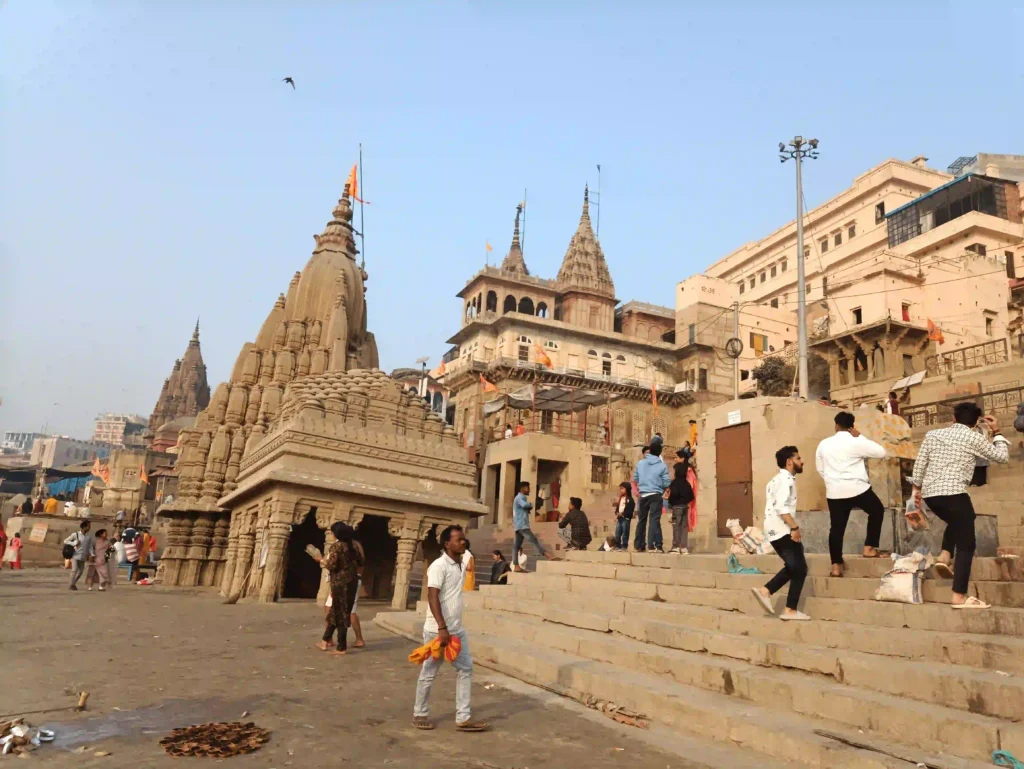
tilted structure.
The Ratneshwar Mahadev Temple, near the Ganga in the
Scindia Ghat area, is famous for its strikingly tilted structure. Its
dramatic lean has led to comparisons with the Leaning Tower of Pisa and
has made it one of the visually distinctive temple structures of
Varanasi.
Local stories offer different explanations for the temple’s unusual
position, including a popular tale involving a curse or the displeasure
of a mother. These stories are part of local folklore; the physical
inclination of the structure is an architectural and structural
phenomenon rather than proof of the legend.
📍 View Ratneshwar Mahadev Temple on Google Maps
281. Why has the Kashi Vishwanath Temple been rebuilt and reconstructed over time?
The history of the Kashi Vishwanath Temple includes
periods of destruction, reconstruction and renewal. The present temple
structure is associated with the reconstruction undertaken by
Maharani Ahilyabai Holkar in 1780, while the sacred significance of
Vishwanath in Kashi is much older.
Traditions surrounding the temple also speak of the sacred Jyotirlinga
being protected during periods of political upheaval. Stories about the
sacred linga and the Gyan Vapi area form an important part of Kashi’s
religious memory.
It is useful to distinguish between
documented temple history and devotional traditions
when discussing the long history of Kashi Vishwanath.
Varanasi Folklore, Faith and Cultural Stories
282. Is it true that dying in Varanasi grants moksha?
A central Hindu belief associated with Kashi is that
dying in Varanasi can lead to moksha, or liberation
from the cycle of birth and rebirth. This belief is one of the reasons
Kashi has attracted pilgrims, ascetics and people seeking spiritual
liberation for centuries.
In religious tradition, the idea is closely associated with Lord Shiva
and the sacred power of Kashi. It is a matter of faith and spiritual
belief, not something that can be scientifically measured or verified.
283. What is the story behind Hanuman’s connection with Kashi?
One of the best-known traditions associated with Hanuman in Varanasi is
connected with Sankat Mochan Hanuman Temple. According
to tradition, Goswami Tulsidas had a profound spiritual connection with
Hanuman and established the temple as a place of devotion.
The temple’s name, Sankat Mochan, means the remover of troubles. For
devotees, Hanuman represents strength, protection, devotion and freedom
from difficulties.
For more about this important shrine, see our
Sankat Mochan Temple, Varanasi
guide.
284. Why are the narrow lanes of Varanasi considered special?
The narrow lanes of old Varanasi are more than a practical feature of
the city’s historic neighbourhoods. They form a maze of temples, homes,
shrines, traditional businesses and pathways leading towards the ghats.
Some spiritual interpretations describe the lanes as part of the sacred
body of Kashi, while others simply see them as an important expression
of the city’s historic urban character.
Walking through these lanes can therefore feel like moving through
several layers of Varanasi’s history at once—religious, architectural,
social and cultural.
285. What is the story of the Ganges descending to Earth?
The descent of the Ganga to Earth is one of India’s
best-known sacred stories. According to Hindu mythology, King Bhagiratha
performed intense penance to bring Ganga down to Earth so that his
ancestors could attain spiritual purification.
Because Ganga’s force was considered too powerful, the river is
traditionally said to have been received by the matted hair of Lord
Shiva before flowing onto the Earth.
Varanasi holds a special place in this sacred geography because the Ganga
forms the city’s spiritual heart and flows past its celebrated ghats.
286. Is there a legend about Baba Keenaram in Varanasi?
Baba Keenaram is remembered as an important saint
associated with the Aghora tradition. His name is closely connected with
Krim Kund and the spiritual traditions of Varanasi.
Stories surrounding Baba Keenaram describe extraordinary spiritual
experiences, compassion and miraculous events. Such accounts belong to
the devotional and hagiographical traditions surrounding the saint and
should be understood in that cultural context.
His legacy remains an important part of the diverse spiritual traditions
that have developed in and around Kashi.
287. Why is Varanasi called the City of Light, or Kashi?
The name Kashi is traditionally associated with the
Sanskrit root kash, meaning to shine or illuminate. This is why
Kashi is commonly interpreted as the “City of Light.”
The expression is not simply about physical light. In Hindu philosophical
and religious traditions, light is also associated with knowledge,
consciousness and the removal of spiritual darkness.
This symbolism is central to the identity of Kashi and helps explain why
the city has long been associated with learning, spiritual practice and
liberation.
For a broader introduction to this identity, see our English guide:
Kashi: A Soulful Journey to the World’s Oldest Living City
.
288. What is the Kashi Panchkroshi Yatra?
The Kashi Panchkroshi Yatra is an important pilgrimage
tradition associated with the sacred geographical boundary of Kashi.
Pilgrims traditionally undertake the route on foot, visiting important
temples and sacred sites along the way.
The traditional pilgrimage is often described as a journey of
approximately 80 kilometres, although the exact experience can vary
depending on the route and modern pilgrimage arrangements.
Its importance lies not simply in distance but in the idea of completing
a sacred circumambulation of Kashi and receiving the spiritual merit
associated with the pilgrimage.
289. Does the Dom Raja really have a royal lineage in Kashi?
The Dom Raja occupies a distinctive place in the social
and ritual history of Varanasi, particularly in connection with the
cremation traditions of the city’s major ghats.
Popular traditions connect the Dom community and the right to manage
cremation fires with ancient stories involving King Harishchandra.
Over time, the title “Dom Raja” became associated with a hereditary
position of considerable ritual importance.
The historical details and traditional accounts should be kept separate,
but the role itself reflects the complex social and religious history
surrounding death and cremation in Kashi.
290. What is the tradition of Akash Deep during Kartik month?
Akash Deep is a devotional tradition observed during
the month of Kartik, when lamps are placed high above the ground,
including near the sacred riverfront in many parts of Varanasi.
The lamps are associated with devotion, remembrance and the offering of
light. In some traditions, they are also connected with departed
ancestors and the spiritual symbolism of guiding light.
The practice is therefore both visually striking and deeply connected
with the religious atmosphere of Kartik in Kashi.
291. Why are bulls given so much respect in the streets of Varanasi?
In Hindu tradition, the bull Nandi is the sacred vehicle
and devoted companion of Lord Shiva. Since Shiva is regarded as the
presiding deity of Kashi, Nandi naturally has a strong presence in the
religious culture of Varanasi.
Bulls can be seen in the city’s lanes and neighbourhoods, and many
residents treat them with respect or offer them food.
The practice reflects the way religious symbolism is woven into ordinary
daily life in Kashi.
292. Is there really a hidden tunnel from Varanasi to Sarnath?
Stories about underground passages and hidden tunnels are part of the
wider folklore surrounding ancient cities, including Varanasi. Some
local accounts suggest that underground routes once connected important
religious or historical locations.
However, there is no established archaeological evidence
confirming a secret tunnel connecting Varanasi and Sarnath in
the way popular stories sometimes describe.
Sarnath is historically significant in its own right as the place where
the Buddha is traditionally said to have delivered his first sermon
after enlightenment. The mystery of underground passages is therefore
best treated as folklore rather than established history.
293. What is the story of Annapurna Devi feeding Lord Shiva in Kashi?
A beloved Kashi legend tells of Goddess Annapurna, the
divine mother associated with food and nourishment. According to the
story, Lord Shiva once demonstrated that the material world was
ultimately an illusion, but Goddess Annapurna showed the importance of
food and nourishment in sustaining life.
In the Kashi tradition, Shiva is said to have accepted food from
Annapurna, symbolising the relationship between spiritual wisdom and
the material nourishment needed for life.
The Annapurna Temple near Kashi Vishwanath remains an important part of
this sacred tradition.
294. Why is King Harishchandra’s truthfulness famous in Varanasi?
King Harishchandra is celebrated in Indian tradition
as a symbol of uncompromising truthfulness. According to the traditional
story, he endured extreme hardship while keeping his promise and
eventually worked at a cremation ground.
This story is closely associated with Harishchandra Ghat
in Varanasi, which continues to carry his name and memory.
Whether approached as sacred legend, moral literature or cultural
heritage, the story represents the enduring ideal of satya—
truth.
295. Is Gyan Vapi really a source of wisdom?
The name Gyan Vapi is commonly translated as the
“Well of Knowledge.” It occupies an important place in the religious
landscape associated with Kashi Vishwanath.
Kashi traditions attach deep spiritual significance to the well and its
association with the sacred history of Vishwanath. However, claims that
drinking its water provides instant enlightenment should be understood
as devotional belief rather than a scientifically established effect.
The symbolism of the name is itself significant: knowledge is
traditionally regarded in Indian philosophy as a path from ignorance
towards spiritual understanding.
296. What is the significance of the Nine Durgas of Varanasi?
The Nine Durgas of Kashi represent nine forms of
Goddess Durga worshipped at different sacred sites associated with
Varanasi’s religious geography.
The tradition becomes especially significant during Navratri, when
devotees visit and worship different forms of the Goddess.
Rather than being simply a collection of temples, the Nine Durga
tradition reflects the way pilgrimage, sacred geography and goddess
worship are woven into the religious life of Kashi.
297. Why is the Kashi Naresh associated with the spiritual identity of Varanasi?
The Kashi Naresh, or traditional ruler of Kashi, has
historically held an important cultural and ceremonial position in
Varanasi.
The royal family has been closely associated with major religious and
cultural events, particularly the famous Ramnagar Ramlila tradition.
Over time, devotional expressions have sometimes described the ruler
in highly sacred terms.
It is more accurate to understand this as a
traditional cultural and ceremonial relationship with Kashi,
rather than stating as historical fact that the ruler is literally an
incarnation of Lord Shiva.
298. What is the significance of Bhairava in Varanasi?
Kaal Bhairav is one of the most important protective
deities of Kashi. In local religious tradition, he is regarded as the
guardian or Kotwal of Kashi, a powerful protector of
the sacred city.
Kashi is also associated with traditions concerning multiple forms of
Bhairava, including the Ashta Bhairava concept found in Hindu sacred
traditions.
For devotees, Bhairava represents protection, discipline and the
removal of obstacles. His role is an important part of understanding
the spiritual geography of Varanasi.
Read our dedicated English guide to the
Kaal Bhairav Temple, Varanasi
.
299. Is there a Sun Temple tradition in Varanasi?
Yes. Kashi’s religious geography includes traditions connected with
Aditya, or forms of the Sun deity. Traditional
accounts speak of multiple Aditya shrines associated with different
parts of the sacred city.
One of the best-known sites connected with Sun worship is
Lolark Kund, which has long been associated with
religious observances and prayers connected with the Sun.
These traditions demonstrate that the sacred landscape of Varanasi is
not limited to Shiva worship; it includes many interconnected forms of
Hindu religious practice.
300. What makes the ‘Sound of Kashi’ different from other cities?
Varanasi has a distinctive soundscape created by temple bells,
devotional chants, Ganga Aarti, conch shells, music, pilgrims, boats,
markets and the everyday movement of the old city.
Some spiritual seekers describe experiencing an inner sense of
Om or sacred vibration while sitting quietly near the
ghats. This should be understood as a personal spiritual experience
rather than a scientifically measurable sound that is unique to
Varanasi.
Perhaps the real “sound of Kashi” is the combination of sacred and
ordinary life happening together—the bells of a temple, a chant from a
shrine, the sound of the Ganga and the conversations of people in the
ancient lanes.
If you want to experience one of the city’s most recognizable evening
traditions, read our English guide:
Varanasi Ganga Aarti: Timings, Best Viewing Spots, Boat Guide & Travel Tips
.
What Makes the Legends of Kashi So Enduring?
The stories of Varanasi survive because Kashi is not simply a historical
destination. It is a living cultural landscape where temples, rituals,
pilgrimage, mythology, architecture, music and everyday life continue
to overlap.
Some stories are preserved in scriptures and religious traditions.
Others have travelled through oral storytelling and local memory.
Still others are connected with historical places whose meanings have
evolved over generations.
That mixture of faith, history, folklore and living
tradition is what makes Varanasi so fascinating.
Plan Your Varanasi Journey
Exploring these legends becomes even more meaningful when you understand
the city behind them. Before visiting, continue exploring our English
Varanasi resources for the city’s spiritual history, temples and
practical travel information.
Start with our
Kashi: A Soulful Journey to the World’s Oldest Living City
guide to understand the broader identity of Kashi.
For accommodation planning, see our
Varanasi Stay Guide
and compare your location, transport access, budget and itinerary before
booking.
Travel note: Temple timings, access rules, crowd
conditions, local transport, prices and other practical details can
change. Verify important information locally or with the relevant
official source before travelling.
Continue the Varanasi Revolutionary FAQ
This is Part 12 of the Varanasi Revolutionary FAQ
series, covering Questions 276–300.
Continue with
Part 13: Nature, Wildlife & Eco-Tourism
and explore the next set of questions in the Varanasi FAQ series.
You can also return to the
Ultimate Varanasi Guide: 500 Questions
to explore the wider series.
A Note About the Legends in This Guide
The stories presented in this section include Hindu religious traditions,
temple legends, local folklore, oral traditions and historical
interpretations associated with Varanasi. Not every traditional account
can be independently verified as a historical or scientific fact.
Where appropriate, beliefs and legends have been identified as
traditions rather than presented as proven facts. Visitors are
encouraged to approach these stories with respect for their religious
and cultural significance while also distinguishing faith, folklore
and documented history.
This guide is intended for cultural, spiritual and travel information
and should not be treated as a substitute for official temple notices,
archaeological records or scholarly historical research.