
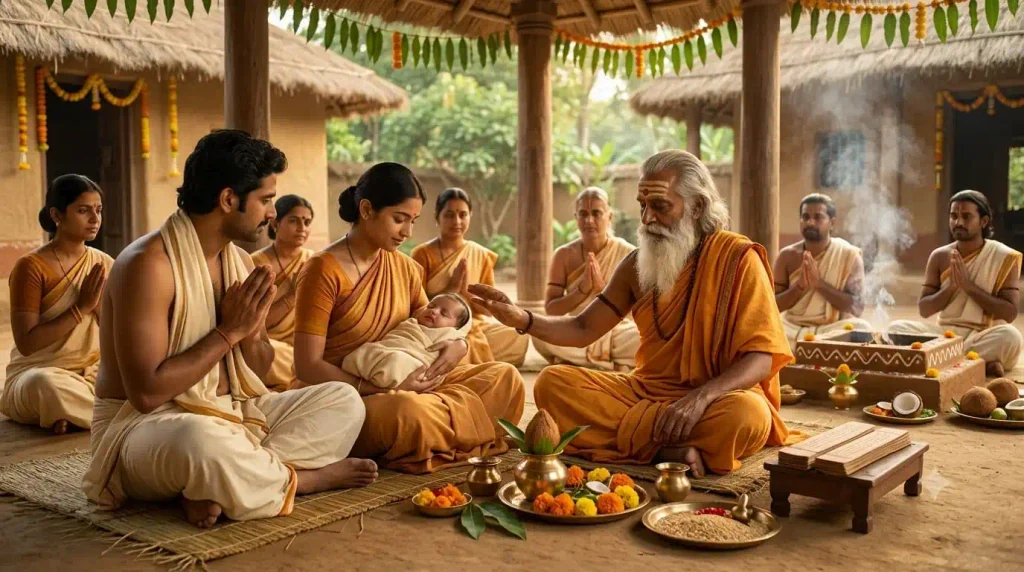
The Namkaran Sanskar (नामकरण संस्कार) is one of the traditional Hindu samskaras performed to formally give a name to a newborn baby. The ceremony is an occasion for parents and family members to pray for the child’s well-being, happiness, good fortune and a blessed life.
In Hindu tradition, a child’s name may be selected with reference to the family’s customs, the baby’s birth star (Nakshatra), the naming practices described in traditional texts, and the family’s chosen deity. The exact procedure, date and rituals may vary according to the family’s tradition, regional customs and the guidance of a knowledgeable priest.
This guide explains the traditional references, suitable timing, puja samagri and a practical step-by-step procedure for performing Namkaran Sanskar at home. It also distinguishes the instructions found in traditional texts from customs commonly followed by families today.
Quick Information About Namkaran Sanskar
| Topic | Details |
|---|---|
| Sanskrit Name | नामकरण संस्कार (Namkaran Sanskar) |
| Meaning | The traditional naming ceremony for a newborn |
| Purpose | To formally name the child and pray for the child’s well-being and auspicious future |
| Traditional Timing | Commonly on the 10th or 12th day after birth, or on another suitable date according to family tradition and the priest’s guidance |
| Main Participants | Parents, close family members and a priest, if invited |
| Main Rituals | Prayer, Sankalp, worship according to family tradition, announcement of the name and blessings for the child |
| Puja Samagri | Kalash, flowers, rice, kumkum, turmeric, diya, fruits, sweets and other items according to the chosen procedure |
| Ceremony Duration | Depends on the rituals and family tradition; a simple household ceremony may be relatively brief |
| Important Safety Note | Never give honey or ritual substances to a baby under 12 months of age |
What Is Namkaran Sanskar?
Namkaran Sanskar is traditionally counted among the Hindu samskaras, or important rites of passage. The ceremony marks the formal naming of a child and provides an opportunity for the family to offer prayers and blessings.
Traditionally, the name may be selected with consideration of the child’s birth star, family deity, month of birth, family customs or a name chosen by the parents. Not every family follows the same naming system, and the number of names given to a child may also differ.
The purpose of the ceremony is not merely to announce a name. It is also a family occasion for expressing gratitude, praying for the child’s well-being and welcoming the newborn into the family’s cultural and spiritual traditions.
What Do Hindu Scriptures Say About Namkaran?
Several traditional Hindu texts discuss naming practices. The relevant passages should be understood in their historical and ritual context rather than treated as a single, identical procedure followed by every Hindu family today.
1. Manusmriti: Traditional Timing for Naming
Manusmriti 2.30 discusses the naming of a child and refers to the 10th or 12th day after birth, or another auspicious time.
Manusmriti 2.30:
नामधेयं दशम्यां तु द्वादश्यां वापि कारयेत्।
पुण्ये तिथौ मुहूर्ते वा नक्षत्रे वा गुणान्विते॥
The verse is commonly understood as recommending that the naming ceremony be performed on the 10th or 12th day, or at an auspicious time associated with a suitable tithi, muhurta or nakshatra.
Important clarification: The timing selected by a family may differ according to regional customs, the baby’s circumstances and the advice of a priest. The 101st day is followed in some traditions, but it should not be presented as a direct instruction of Manusmriti 2.30.
2. Manusmriti: Traditional Naming Guidelines
Manusmriti 2.31–2.33 discusses traditional conventions for names. Some of these recommendations are connected with the historical social framework of the text. They should therefore be presented as textual traditions rather than universal requirements for every family today.
Manusmriti 2.33 gives a guideline for a girl’s name:
स्त्रीणां सुखोद्यमक्रूरं विस्पष्टार्थं मनोहरम्।
मङ्गल्यं दीर्घवर्णान्तमाशीर्वादाभिधानवत्॥
The verse is generally understood as recommending a feminine name that is easy to pronounce, gentle, clear in meaning, pleasant, auspicious and ending in a long vowel sound.
The verse does not prescribe an exact three-syllable or five-syllable rule for every girl’s name. Such specific syllable patterns should not be presented as a universal requirement of Manusmriti.
For readers who want to understand the text in greater detail, see our guide: What Is the Manusmriti?
[Add the live Manusmriti guide URL here when it is available for linking.]
3. Paraskar Grihya Sutra: Naming and Syllable Traditions
The Paraskar Grihya Sutra, a traditional text on domestic rites, also discusses naming practices.
Its Namkaran section is commonly referenced for the practice of naming a child around the 10th day after birth. The text also contains traditional guidance about the structure of names.
A commonly described distinction is:
- Boys’ names: Traditionally, an even number of syllables is recommended, particularly two or four.
- Girls’ names: Traditionally, an odd number of syllables and a long final vowel are recommended.
These are traditional textual guidelines. Families today may follow them, adapt them or choose names according to their own religious, linguistic and personal preferences. They should not be treated as compulsory rules for every Hindu child’s name.
Four Traditional Approaches to Naming a Child
Some Hindu naming traditions consider four approaches when selecting a child’s name. These are best understood as four naming considerations, not as a universal rule that every child must have four separate names.
1. Nakshatra Name
The Nakshatra name is selected with reference to the child’s birth star and the syllable traditionally associated with it. Families who follow Vedic astrology may consult a Panchang or a knowledgeable priest to identify the relevant syllable.
This is a customary approach, and families may choose whether to use it.
2. Maas Name
Some traditions consider the Hindu lunar month in which the child was born when selecting a name. Particular names or naming associations may be followed in specific traditions.
The exact practice can vary, so a single list should not be presented as a rule followed by every Hindu family.
3. Kuldevta or Family-Deity Name
Some families choose a name inspired by their Kuldevta, Kuldevi or a deity worshipped in the family. For example, a family devoted to Lord Rama, Lord Krishna, Lord Shiva or Goddess Durga may prefer a name associated with that deity.
This is a matter of family devotion and tradition rather than a compulsory naming requirement.
4. Vyavahar Name
The Vyavahar name is the name used in everyday life. It may be the name announced during Namkaran and later used in school records, official documents and ordinary family interactions.
Do all children need four different names?
No. These are different traditional naming approaches, and they do not necessarily mean that a child must have four distinct names. A family may select one name that satisfies its preferences, or it may follow a particular naming custom recommended by its priest.
When Should Namkaran Sanskar Be Performed?
The date of Namkaran Sanskar depends on the family’s tradition and the circumstances of the newborn.
Commonly followed approaches include:
- 10th day after birth: Mentioned in traditional naming references.
- 12th day after birth: Also mentioned in Manusmriti 2.30.
- Another auspicious date: Some families choose a suitable tithi, nakshatra or muhurta with the guidance of a priest.
- A later date: Families may postpone the ceremony because of the baby’s health, the mother’s recovery, travel or other practical circumstances.
The mother and baby’s health and comfort should take priority. A family need not rush a ceremony if the newborn or mother requires rest or medical care.
How to Choose a Muhurat
If the family wishes to follow an astrological muhurat, it may consult a local Panchang or a knowledgeable priest. The date and time can depend on the location and the tradition being followed.
A general online muhurat should not be treated as a personalised calculation for every city or family. Confirm the selected date and time locally, especially if the ceremony is being planned around a particular tithi or nakshatra.
Namkaran Puja Samagri List
The following list is suitable for planning a simple household ceremony. Not every item is mandatory in every tradition. The priest may recommend additional items according to the family’s ritual practice.
| Item | Purpose or Use |
|---|---|
| Clean puja chowki or platform | To arrange the puja items |
| Clean cloth | To cover the puja platform |
| Kalash and clean water | For the traditional puja arrangement |
| Mango leaves and coconut | Used in many customary puja arrangements |
| Kumkum and turmeric | For customary worship and auspicious markings |
| Akshat (uncooked rice) | Used in traditional worship |
| Fresh flowers | For offering during puja |
| Diya and cotton wicks | For the traditional lighting ritual |
| Ghee or suitable diya oil | For lighting the diya |
| Incense sticks | Optional; use only if safe and well ventilated |
| Fruits and sweets | For offering and distribution as prasad |
| Betel leaves and supari | Optional; include if required by the family’s tradition |
| Panchamrit | Optional; for the puja arrangement only, not for feeding the newborn |
| Baby’s clean clothes | To dress the child comfortably |
| A clean, comfortable place for the baby | To keep the child safe during the ceremony |
| Dakshina | If a priest is invited, according to the family’s custom |
| Havan samagri | Only if a havan is planned and appropriate arrangements are available |
Important Note About Samagri
The list above is a practical preparation guide, not a claim that every item is required by the Paraskar Grihya Sutra. Ritual requirements differ among families, regions and priestly traditions.
Do not put honey, Panchamrit, water, ghee, herbs, prasad or any other ritual substance into a newborn’s mouth. These items may be used for the puja arrangement, but they must not be fed to the baby.
How to Perform Namkaran Sanskar at Home: Step-by-Step Vidhi
The following is a practical household procedure based on commonly followed Hindu customs. It is intended to help families organise a respectful naming ceremony. It should not be understood as an exact reproduction of every Vedic Grihya Sutra ritual.
If the family follows a specific Vedic tradition, the invited priest may adapt the procedure accordingly.
Step 1: Prepare the Puja Area
Choose a clean and peaceful area in the home. Arrange the puja chowki, clean cloth, kalash, flowers, rice, kumkum, turmeric, diya and other selected items.
Keep the baby in a comfortable, safe place away from the diya, incense, hot liquids and small ritual objects.
The ceremony should be arranged so that the mother and baby can remain comfortable throughout.
Step 2: Begin with Prayer and Sankalp
Family members may begin with a prayer to their chosen deity or with a customary invocation of Lord Ganesha.
The person leading the ceremony may take a Sankalp, stating the intention to perform Namkaran Sanskar for the child and to pray for the child’s well-being.
The exact Sankalp wording can differ by tradition. A priest can provide the appropriate wording if the family wishes to follow a specific ritual procedure.
Step 3: Perform the Chosen Puja
The family may perform a simple puja to its Ishta Devta or Kuldevta. Flowers, akshat, kumkum and other customary offerings may be presented according to the family’s practice.
Some families include a havan, while others perform a simple prayer without one.
Havan is not necessary for every household naming ceremony. If a havan is included, it should be conducted by a knowledgeable adult or priest in a suitable, well-ventilated place, with the baby kept safely away from fire and smoke.
For a related household puja guide, see How to Perform Ganesh Sthapana.
Step 4: Select or Confirm the Baby’s Name
Parents may select the name before the ceremony or confirm it during the ceremony, according to their custom.
The name may be chosen with reference to:
- The child’s birth star or Nakshatra.
- The family’s religious and cultural traditions.
- The family deity or a respected family member.
- The meaning, pronunciation and personal significance of the name.
- The parents’ own preferences.
If the family is following a Nakshatra-based naming practice, the associated syllable may be checked with a Panchang or priest. The family is not required to use a particular syllable if it follows a different naming custom.
Step 5: Announce the Name
The chosen name may be announced to the family members present. Some families have the parents or another close family member say the name softly near the baby’s right ear.
A related practice of speaking into the baby’s ear appears in traditional Hindu texts, including the Brihadaranyaka Upanishad in a different ritual context. However, the precise method and wording used during contemporary Namkaran ceremonies can vary.
There is no need to claim that the name must be whispered a fixed number of times or through a betel leaf unless that practice is specifically part of the family’s tradition.
The baby should be held securely and gently. Do not force the baby’s head or ear into a particular position.
Step 6: Offer Blessings for the Child
Parents and family members may offer prayers and blessings for the child’s health, happiness, wisdom, kindness and well-being.
Blessings can be expressed in the family’s own words or through traditional prayers used in that family. There is no single wording that every household must use.
Step 7: Offer Prasad
Fruits or sweets may be offered during the puja and distributed to adult family members and other guests.
Do not feed prasad, honey, Panchamrit, water or any other ritual substance to a baby under 12 months of age. The offerings are for the puja and suitable family members, not for the newborn.
Step 8: Conclude the Ceremony
Conclude with a prayer or customary Aarti, if included in the family’s practice. Thank the priest and family members who participated.
If a priest was invited, dakshina may be offered according to the family’s custom and means.
The ceremony can then conclude with the family sharing the baby’s name and blessings. Keep the event flexible so the mother and baby can rest whenever needed.
Which Mantra Is Used During Namkaran Sanskar?
The mantras used during Namkaran Sanskar depend on the family’s Vedic tradition, the priest’s practice and the specific ritual being performed.
Some families use mantras for Lord Ganesha, their Kuldevta or their Ishta Devta. A priest may also recite relevant mantras from the family’s ritual tradition.
A Sanskrit verse sometimes quoted in connection with a child’s birth begins with the words:
अङ्गादङ्गात् सम्भवसि हृदयादधिजायसे।
A related passage appears in the Brihadaranyaka Upanishad 6.4.9 in a different ritual context. The complete wording found in modern articles may vary, so this verse should not automatically be described as the universally prescribed Namkaran mantra.
For an authentic Vedic procedure, ask the priest to provide the mantra and its source according to the family’s tradition. It is better to identify a mantra accurately than to assign a verse to a ritual without confirming its context.
Namkaran Sanskar and Nishkramana Sanskar: What Is the Difference?
Namkaran and Nishkramana are distinct traditional samskaras. They should not be treated as the same ceremony.
Namkaran Sanskar
Namkaran is the naming ceremony. Its central purpose is to give or formally announce the child’s name and to offer prayers and blessings.
Nishkramana Sanskar
Nishkramana is traditionally associated with taking the child outside the home for the first time in a ceremonial sense. Traditional descriptions connect it with the baby’s later infancy, often around the fourth month, although practices vary.
The Paraskar Grihya Sutra discusses Nishkramana separately from Namkaran. The traditional association of Nishkramana with going outside or seeing the sun should therefore not be presented as a mandatory part of every Namkaran ceremony.
Families may combine customs for practical reasons, but the two rites have different traditional purposes.
Can Namkaran Sanskar Be Performed Without a Priest?
Many families perform a simple naming ceremony at home with prayers, the announcement of the child’s name and blessings from family members.
Whether a priest is necessary depends on the family’s tradition and the level of ritual detail desired. Families wishing to follow a particular Grihya Sutra or Vedic procedure may prefer guidance from a knowledgeable priest.
There is no need to present one household arrangement as the only valid practice for every Hindu family.
If you want assistance arranging a puja, see Online Puja Booking Ayodhya & Kashi.
Important Safety Guidelines for a Newborn
A naming ceremony should always be arranged around the baby’s health, comfort and safety.
- No honey for babies under 12 months: Honey can cause infant botulism and must not be given to a baby under one year of age, even as part of a religious ritual.
- Do not feed ritual substances: Never place Panchamrit, water, herbs, ghee, sweets or other puja substances in the newborn’s mouth.
- Keep fire and smoke away: Place the baby well away from diyas, havan flames, incense and smoke.
- Avoid small objects: Keep rice grains, supari, beads, coins and other small objects away from the baby to prevent choking.
- Prioritise the mother’s and baby’s health: Postpone or simplify the ceremony if either needs rest or medical care.
- Use safe handling: Ensure that an adult supports the baby’s head and body properly throughout the ceremony.
These safety precautions do not diminish the religious significance of Namkaran. They help the family celebrate the occasion responsibly.
Common Mistakes to Avoid During Namkaran Sanskar
- Treating every custom as a compulsory scriptural rule: Traditions vary, and not every household practice is directly prescribed in a particular Grihya Sutra.
- Confusing Namkaran with Nishkramana: Naming and the traditional ceremonial outing are separate rites.
- Assuming every child must have four names: The four naming approaches are not a universal requirement for four distinct names.
- Using an unverified mantra attribution: Confirm the source and context before describing a verse as the prescribed Namkaran mantra.
- Insisting on a particular date regardless of circumstances: The mother’s and baby’s well-being should come first.
- Giving honey or ritual substances to the baby: Ritual offerings must not be fed to a newborn.
- Using fire or incense too close to the child: Maintain a safe distance and avoid smoke exposure.
Frequently Asked Questions About Namkaran Sanskar
1. On which day should Namkaran Sanskar be performed?
Manusmriti 2.30 refers to the 10th or 12th day after birth, or another auspicious time. Families may follow other dates according to regional custom, the baby’s circumstances and their priest’s guidance.
2. Is Namkaran compulsory on the 10th or 12th day?
These days are mentioned in traditional references, but families may follow different customs. The ceremony can be planned for a suitable later date if the mother or baby needs additional rest or care.
3. Is a priest necessary for Namkaran Sanskar?
Not in every family tradition. Some families perform a simple household ceremony themselves, while others invite a priest for Sankalp, mantras and a more detailed ritual.
4. Does a child need four different names?
No. Nakshatra, Maas, Kuldevta and Vyavahar are four traditional naming approaches. They do not mean that every child must have four separate names.
5. Is a Nakshatra-based name compulsory?
No. Some families use the syllable associated with the baby’s birth star, while others select a name based on meaning, family tradition, devotion or personal preference.
6. Is havan mandatory during Namkaran Sanskar?
Havan is included in some ceremonies but is not necessary for every household naming ceremony. The procedure depends on the family’s tradition and the ritual being followed.
7. Should the baby be given honey during Namkaran?
No. Honey must not be given to babies under 12 months because of the risk of infant botulism. The same principle applies to ritual mixtures and other substances that are not suitable for the baby’s age.
8. Is Nishkramana part of Namkaran Sanskar?
No. They are distinct traditional rites. Namkaran concerns naming the child, while Nishkramana is associated with the ceremonial outing of the child from the home.
9. Can the name be whispered into the baby’s right ear?
Some families follow this custom, and traditional texts contain related practices in other ritual contexts. The exact method is not identical in every Namkaran tradition, so follow the family’s custom or the priest’s guidance without forcing the baby’s position.
10. Can Namkaran Sanskar be performed at home?
Yes. A family may organise a simple ceremony at home with prayers, the announcement of the name and blessings. Those seeking a specific Vedic procedure may consult a knowledgeable priest.
Related Guides on BookAyodhyaKashi
Explore these related guides for household puja and travel planning:
- How to Perform Ganesh Sthapana
- Online Puja Booking Ayodhya & Kashi
- How to Reach Ayodhya: Travel Guide
- Essential Travel Accessories for Ayodhya and Kashi
Disclaimer
This article is intended for general religious and educational information. Hindu naming customs and ritual procedures vary by region, family tradition and Vedic school. The scriptural references discussed here should be understood in their specific textual contexts and not as a claim that every custom is compulsory for every Hindu family.
For a ceremony following a specific family or Vedic tradition, consult a knowledgeable priest. Choose the ceremony’s date and procedure in a way that respects the health and comfort of the mother and baby.
The medical safety guidance in this article is especially important for newborns. Never give honey to a child under 12 months, and do not put ritual substances into the baby’s mouth.