
Updated on: October 15, 2026 | Category: Online Pooja
Moving into a new home is one of the most meaningful milestones in family life. In Hindu tradition, Griha Pravesh Puja is performed to mark this new beginning with prayers for peace, prosperity, health, and harmony.
If you are wondering how to perform Griha Pravesh, which puja materials to arrange, how to select an auspicious muhurat, or what to do if a priest or havan arrangement is unavailable, this guide explains the process step by step.
Whether you are moving into a newly constructed house, a purchased property, a flat, or a rented home, you can use this guide to prepare for the ceremony. Follow the main procedure below and adapt the arrangements to your family’s established customs and practical circumstances.
Quick Guide: Griha Pravesh at a Glance
- Prepare the home: Clean the house, arrange the puja area, and collect the necessary samagri.
- Choose a muhurat: Consult a reliable local Panchang or a knowledgeable priest if you want to follow a traditional auspicious timing.
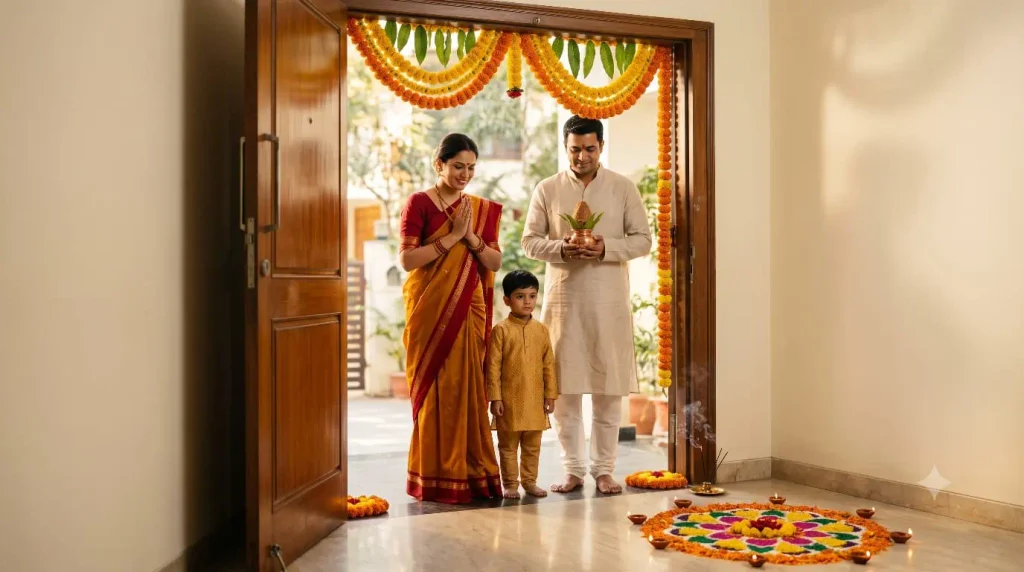
- Prepare the entrance: Decorate the doorway with a toran and arrange a Kalash if it is part of your family’s custom.
- Perform the puja: Begin with prayers to Lord Ganesha, take a sankalp, offer prayers to the household deities and Vastu Purusha, and conduct havan if planned and safe.
- Complete the kitchen ritual: Boil milk if your family follows this custom, and prepare or offer prasad.
- If a priest is unavailable: Perform a simple devotional prayer at home or arrange remote guidance from a priest.
- After the puja: Offer prasad, conclude the prayers, and begin settling into your new home.
What Is Griha Pravesh Puja?
Griha Pravesh is a Hindu housewarming ceremony performed when a family begins living in a home. It may be conducted for a newly constructed house, a newly purchased property, or another home where the family wishes to mark a fresh beginning.
The ceremony commonly includes prayers to Lord Ganesha, a sankalp, offerings to deities according to the family’s tradition, and customs associated with entering the home and beginning to use its kitchen.
The exact ritual sequence varies among Hindu communities. For a typical family ceremony, the practical approach is to prepare the home, select a suitable time, perform the chosen puja, and conclude with prayers and prasad.
Traditional Significance of Griha Pravesh
Hindu domestic traditions place importance on the home as a place of family life, responsibility, worship, and hospitality. Griha Pravesh expresses gratitude and the hope that the household will be peaceful and well cared for.
1. Prayer to Vastoshpati — Rigveda 7.54.1
Rigveda 7.54.1 contains a prayer addressed to Vastoshpati, the guardian of the dwelling.
वास्तोष्पते प्रति जानीह्यस्मान् स्वावेशो अनमीवो भवा नः।
यत् त्वेमहे प्रति तन्नो जुषस्व शं नो भव द्विपदे शं चतुष्पदे॥
Reference: Rigveda 7.54.1
Simple meaning: The prayer asks the guardian of the dwelling to be favourable, to grant a comfortable and healthy home, to accept the worshippers’ requests, and to bring well-being to human beings and animals.
This verse provides a meaningful Vedic prayer for household welfare. Families may recite it during a suitable part of their puja, particularly when guided by a priest familiar with the mantra.
2. Guidance from the Paraskara Grihya Sutra
The Paraskara Grihya Sutra is a classical text concerned with Vedic domestic rituals. Its third chapter, fourth section, includes instructions relating to a dwelling and domestic ritual observances.
The text provides historical context for the importance of a properly prepared dwelling and ritual worship. The specific ceremony performed today may also include customs maintained within regional and family traditions.
3. Reverence for the Earth — Atharvaveda 12.1.43
The Bhumi Sukta of the Atharvaveda celebrates the Earth as the foundation of human life.
यस्याः पुरो देवकृताः क्षेत्रे यस्या विकुर्वते।
प्रजापतिः पृथिवीं विश्वगर्भामाशामाशां रण्यां नः कृणोतु॥
Reference: Atharvaveda 12.1.43
Simple meaning: The verse speaks of the Earth on which settlements stand and fields are cultivated, praying that the Earth may make every direction pleasant and welcoming.
This verse is relevant to the broader theme of respect for the Earth and the place where people live. It can be included as a devotional reading or prayer where appropriate.
Common Types of Griha Pravesh
Traditional Vastu and domestic-ritual literature discusses different circumstances in which a family enters or re-enters a dwelling. Some later guides use the following classifications:
1. Apoorva Griha Pravesh
Apoorva is commonly associated with entering a newly constructed home for the first time.
2. Sapurva Griha Pravesh
Sapurva is commonly associated with entering or re-entering an existing home in circumstances such as returning after an extended absence. The precise classification should be determined according to the relevant tradition.
3. Dvandva Griha Pravesh
Some traditional descriptions associate Dvandva with re-entering a home after substantial damage and reconstruction.
Which procedure should you follow?
If you are moving into a newly built house, use the standard Griha Pravesh procedure described below as your practical starting point. If you are moving into a resale property, a rented flat, or a substantially reconstructed house, explain the circumstances to your family priest if you want a traditional ritual classification and corresponding sankalp.
You do not need to assign a Sanskrit category to every modern housing situation before preparing for a simple housewarming ceremony.
How to Choose a Griha Pravesh Muhurat
A Shubh Muhurat is an auspicious time selected according to Hindu astrological and calendar traditions. Families who wish to perform a traditional Griha Pravesh should select the date and timing before finalizing their arrangements.
The Five Limbs of the Panchanga
The Panchanga has five traditional components:
- Tithi: The lunar day.
- Vara: The weekday.
- Nakshatra: The lunar constellation.
- Yoga: A calculated combination of the Sun and Moon’s positions used in traditional calendar interpretation.
- Karana: Half of a lunar tithi.
A priest or astrologer may also consider the Lagna, the rising sign at the selected time, along with other relevant factors according to the family’s tradition.
Which Tithi, Weekday and Nakshatra Should You Choose?
Traditional muhurat guides identify particular tithis, weekdays, and nakshatras as favourable for Griha Pravesh. Recommendations can differ according to the Panchanga, regional practice, and the astrological factors considered.
Rather than choosing a date based on a generic list alone, follow these steps:
- Identify the city where the house is located.
- Check a reliable Panchanga for the intended date.
- Shortlist a suitable date and timing according to your family’s tradition.
- Confirm the final muhurat with a knowledgeable priest if you want a traditional astrological assessment.
- Coordinate the ceremony, moving arrangements, and any havan accordingly.
Why Does the Muhurat Differ by Location?
Sunrise, sunset, and calendar calculations depend on the location. A muhurat listed for one city may not correspond exactly to the same local timing in another city or country.
If you live outside India, use a Panchanga calculated for your local city rather than automatically following an Indian city’s timing.
Practical recommendation: Confirm the local date and time before inviting guests or arranging a priest. If your preferred date is unsuitable, ask for the nearest suitable alternative rather than selecting an exact time from an unrelated calendar.
Griha Pravesh Puja Samagri Checklist
Preparing the materials beforehand makes the ceremony easier to conduct. The following checklist covers the common items for a typical home puja. Additional materials may be needed if your chosen procedure includes a formal Vedic havan.
1. Basic Puja Essentials
- A small wooden chowki or altar table
- A clean red or yellow cloth
- A picture or murti of Lord Ganesha
- A diya with cotton wicks
- Ghee or suitable lamp oil
- Incense and a stable incense holder
- Camphor, if used by your family
- A matchbox or lighter
- A clean plate or tray for offerings
- A small spoon and a clean water vessel
2. Kalash and Entrance Materials
- A clean copper, brass, or stainless steel Kalash
- Clean drinking water
- A whole coconut
- Fresh mango leaves or other leaves used in your tradition
- Mauli or Kalawa sacred thread
- Akshat, or unbroken rice
- Kumkum and turmeric
- Flowers or a doorway toran, if desired
A copper or brass vessel is traditional in many families, but a clean stainless steel vessel can be used for a simple household arrangement where appropriate.
3. Ganesh Puja and Sankalp Materials
- Clean water
- Akshat
- Fresh flowers
- Kumkum and sandalwood paste
- Betel leaves and betel nuts, if required by your chosen procedure
- A coin or other customary sankalp item
- Fruits or sweets for the offering
- A small plate to collect offerings
4. Kitchen Ritual and Prasad
- Fresh milk, if your family follows the milk-boiling custom
- A clean cooking pot
- Rice and sugar or jaggery, if preparing kheer
- Seasonal fruits
- Sweets or another suitable prasad
- Clean serving bowls and spoons
5. Additional Materials for Havan
Arrange these items only if havan is part of the planned ceremony:
- A suitable havan kund
- Dry, appropriate firewood or samidha
- Havan samagri
- Ghee and a suitable offering spoon
- A stable, fire-resistant base and appropriate safety equipment
Do not buy havan materials if an open flame is prohibited or cannot be used safely in your home.
Preparation Checklist
The previous day
- Clean the house and kitchen.
- Arrange the puja area and the required materials.
- Confirm the muhurat and the planned procedure.
- Check whether the building permits an indoor havan.
- Purchase fresh flowers, leaves, milk, fruits, and sweets as needed.
On the ceremony day
- Bathe and wear clean clothes.
- Arrange the Kalash, altar, offerings, and prasad.
- Keep the puja area clear of clutter.
- Ensure that lamps and any planned fire are placed safely.
- Keep children away from flames and hot cooking equipment.
Griha Pravesh Puja Essentials: Online Options
If you need to arrange puja materials before the ceremony, you can explore a ready-made Griha Pravesh puja kit and choose the items appropriate for your planned procedure.
Check Griha Pravesh Puja Essentials on Amazon
A ready-made kit is a convenient option, but check its contents before ordering. You may already have some of the required materials at home.
Step-by-Step Griha Pravesh Puja Vidhi
The following is a practical sequence for a typical family Griha Pravesh ceremony. If a priest is conducting a formal Vedic ritual, follow the priest’s instructions for the specific mantras, offerings, and order of worship.
Step 1: Clean and Prepare the House
Clean the rooms, entrance, kitchen, and area where the puja will take place.
Arrange a small, stable altar with a clean cloth and the images or murtis you intend to worship. Choose a location that is convenient for the family and suitable for the planned ceremony.
Some families prefer the northeast or east area for the prayer space. If that is not practical in a flat or rented property, use a clean, quiet location where the puja can be performed comfortably.
Materials: Clean cloth, chowki, puja images, and basic cleaning supplies.
Step 2: Prepare the Main Entrance
Decorate the entrance with a toran or flowers if desired. Some families mark the doorway with a Swastika using kumkum or turmeric.
If you live in a rented property, use removable decorations and avoid permanent marks unless the owner permits them.
You may sprinkle a little clean water at the entrance as a customary act of preparation. Keep the floor dry enough to prevent slipping.
Materials: Flowers or toran, kumkum, turmeric, and clean water.
Step 3: Prepare the Kalash
If your family follows the Kalash-entry custom:
- Clean the Kalash thoroughly.
- Fill it with clean water.
- Add customary offerings, such as a coin or akshat, if used in your tradition.
- Arrange fresh leaves around its opening.
- Place a coconut securely on top if that is part of your family’s custom.
Keep the Kalash stable and ensure that it is not too heavy to carry safely.
Materials: Kalash, water, leaves, coconut, and optional customary offerings.
If your family does not follow the Kalash-entry custom, you can proceed with the entrance prayer used in your tradition.
Step 4: Enter the Home at the Chosen Muhurat
At the selected time, the family gathers near the entrance.
If your custom includes entering with the right foot first, follow that practice. The head of the household may carry the Kalash, or the family may enter together according to its established custom.
You may chant a familiar prayer, such as:
ॐ नमो भगवते वासुदेवाय।
Alternatively, recite a prayer to Lord Ganesha or your family deity.
Enter calmly and respectfully. There is no need to rush or turn the entry into a complicated sequence of actions.
Step 5: Arrange the Puja Altar and Light the Diya
Place the Kalash securely on the altar if it is being used for the puja. Arrange the deity images, flowers, water, rice, and other offerings.
Place the diya on a stable, heat-resistant tray away from curtains, paper decorations, and furniture. Light it only when an adult can supervise it continuously.
Materials: Kalash, altar, deity images, diya, wick, ghee or lamp oil, and flowers.
If an open flame is not permitted in your building, follow the building’s rules and use an appropriate non-flame devotional arrangement.
Step 6: Perform Ganesh Puja
Begin the worship with a prayer to Lord Ganesha.
A simple devotional prayer is:
ॐ गं गणपतये नमः।
You may offer flowers, akshat, clean water, and a small sweet or fruit. Pray for a peaceful beginning and for the family’s well-being.
If a priest is performing a formal Ganesh Puja, follow the prescribed offerings and mantras.
Step 7: Take the Sankalp
Sankalp is the formal statement of the intention for which a puja is performed.
In a simple household puja, the main performer can state the purpose in clear words:
“We are performing this Griha Pravesh Puja to seek divine blessings for peace, health, harmony, and well-being in our new home.”
A formal Vedic sankalp may include details such as the date, location, family lineage, and other traditional information. If a priest is conducting the ceremony, the priest can guide you through the appropriate wording.
You do not need to invent Sanskrit wording if you are unfamiliar with it. A sincere prayer in a language you understand is a practical option for a simple devotional ceremony.
Step 8: Offer Prayers to Vastu Purusha and the Household Deities
Offer flowers, akshat, and prayers according to your family’s chosen procedure.
You may pray for the well-being of everyone who will live in the home, for peaceful family relationships, and for responsible use of the property.
If your family follows a specific Vastu Puja or Vastu Shanti procedure, arrange the relevant materials and follow the instructions of a knowledgeable priest.
For related guidance, see Vastu Shanti and Puja Guidance.
Step 9: Perform Havan if Planned and Safe
Havan is included in many traditional Griha Pravesh ceremonies. When a formal havan is planned, the priest can guide the family through the fire preparation, mantras, offerings, and concluding prayers.
Before lighting the fire:
- Confirm that the building rules permit it.
- Use an appropriate havan kund and stable, fire-resistant base.
- Keep the fire away from curtains, furniture, decorations, and combustible materials.
- Ensure suitable ventilation and follow local fire-safety requirements.
- Keep children and pets at a safe distance.
- Never leave the fire unattended.
Do not conduct havan beneath a kitchen chimney, close to curtains, or in an unsuitable enclosed space. Never disable or cover smoke alarms to conduct a ritual.
If havan is prohibited or unsafe: Do not light an open fire. Perform the prayers and devotional recitations that are appropriate to your family’s chosen ceremony. If a formal Vedic procedure is intended, ask the priest how it should be adapted rather than assuming that every alternative is equivalent to a prescribed havan.
Step 10: Perform the Kitchen Ritual
In many families, boiling milk in the new kitchen is a customary part of the housewarming celebration. It is often associated with nourishment and abundance.
If your family follows this custom:
- Clean the cooking area.
- Place a suitable pot on a stable cooktop.
- Add the milk and heat it while supervising it continuously.
- Lower the heat before the milk spills over.
- If desired, use the milk to prepare kheer or another suitable offering.
Do not deliberately allow boiling milk to spill across the stove or floor. The custom can be observed safely without risking burns or creating a mess.
If your family does not follow the milk-boiling custom, you can proceed with the remaining prayers and prasad arrangements.
Step 11: Offer Bhog and Perform Aarti
Prepare the chosen offering, such as fruit, sweets, or kheer.
Place it before the deities and offer a prayer of gratitude. Perform aarti if it is part of your family’s practice.
If using camphor or a diya for aarti, keep the flame under control and away from clothing, curtains, and decorations.
After the offering, distribute prasad among family members and guests.
Step 12: Conclude the Puja
Offer a final prayer for the household’s well-being. Thank the deities and conclude the ceremony according to your family’s custom.
Allow the puja area to settle before moving the materials. Do not handle hot vessels, burning wicks, or havan embers until they are safe.
Once the ceremony is complete, the family can share a meal and begin using the home.
Practical Alternatives for Common Situations
Can Griha Pravesh Be Performed Without a Priest?
Yes. If a priest is unavailable, a family can perform a simple devotional housewarming prayer at home.
A practical simplified sequence is:
- Clean the home and prepare a prayer area.
- Enter the house respectfully at a suitable time.
- Offer prayers to Lord Ganesha.
- State the intention of the puja in your own words.
- Offer flowers, water, and a suitable food offering.
- Recite a familiar prayer or stotra.
- Share prasad and conclude the prayer.
If you want a formal Vedic ceremony involving prescribed mantras, a specific sankalp, or havan, seek guidance from a knowledgeable priest.
What If Havan Is Not Possible?
If the building prohibits indoor fire or the home does not have a safe place for havan, do not attempt to conduct it.
You can perform the other appropriate prayers and devotional offerings. If your chosen ritual procedure specifically includes havan, consult the priest about a suitable arrangement or adaptation.
This approach lets you observe a meaningful housewarming prayer without violating safety rules.
What If a Puja Item Is Missing?
First, identify whether the missing item is essential to the particular ritual or simply a customary offering.
For a simple devotional puja, you can often use readily available alternatives:
- Use a clean stainless steel vessel if a brass or copper vessel is unavailable.
- Offer fresh local flowers if a particular flower is unavailable.
- Use clean water for a simple water offering.
- Use another suitable fruit or sweet if the preferred offering is unavailable.
Do not assume that water or rice can replace every ritual item in every formal Vedic procedure. If a specific item is required for the ceremony being performed, ask the priest for an appropriate substitute.
A missing ordinary decorative item does not mean that you must abandon your entire housewarming plan.
Can Griha Pravesh Be Performed in a Rented Flat?
Yes. You can perform a suitable housewarming prayer in a rented home.
Prepare a small, clean prayer area, use removable decorations, and obtain the owner’s permission for anything that could alter the property.
Follow the main devotional procedure and omit any arrangement that is prohibited by the lease or building rules. If you want a formal ritual, explain to the priest that the property is rented and ask which procedure is suitable.
What If You Are Moving Into a Resale or Renovated House?
The appropriate ceremony can depend on the circumstances and the family’s tradition.
For a purchased property, clean the home, prepare the prayer area, and select a suitable date if you want to perform a formal Griha Pravesh. For a major reconstruction after serious damage, discuss the details with your priest.
Ordinary repairs, painting, or routine maintenance do not automatically require the same ceremony as entering a newly constructed home.
What If Your Apartment Has Limited Space?
Choose a clean, stable corner for the altar and arrange only the materials you need.
A compact puja can be performed without a large setup. If the apartment does not have a suitable fire-safe area, omit the physical havan and follow the appropriate prayer arrangements instead.
Important Safety Guidance
Religious observances should always be conducted with care.
- Never leave a burning diya, incense holder, camphor flame, or havan fire unattended.
- Keep flames away from curtains, paper decorations, furniture, and other combustible materials.
- Do not conduct havan under a kitchen chimney or close to curtains.
- Never cover, disable, or bypass smoke alarms or other fire-safety equipment.
- Follow building rules and local fire-safety requirements.
- Do not attempt an indoor havan if a suitable fire-safe area and ventilation are unavailable.
- Supervise milk and other food while cooking.
- Keep children and pets away from hot vessels and open flames.
- Ensure all lamps and embers are fully extinguished and safe before leaving the house or going to bed.
What to Do After Griha Pravesh
Once the puja and aarti are complete, follow these practical steps:
1. Distribute Prasad
Share the offered sweets, fruits, or other prasad with family members and guests.
2. Share a Meal
Many families prepare or share a vegetarian meal after the ceremony. Follow your family’s custom and arrange food according to the guests and facilities available.
3. Clean the Puja Area
Once all flames and vessels are completely cool, put away reusable items and tidy the prayer area. Dispose of flowers and other organic offerings respectfully, following your family’s practice and local rules.
4. Settle Into the Home
Begin arranging furniture, unpacking belongings, and organizing the kitchen and bedrooms.
Some families traditionally spend the first night in the new home. If this is part of your family’s practice and circumstances permit, you may follow it.
Home Appliances for Your New Home
After moving into a new home, you may also need everyday appliances for cooking, food storage, laundry, and family comfort.
Choose appliances according to your available space, household needs, budget, and electricity requirements. You can explore options for your new home below.
Explore Home Appliances for Your New Home on Amazon
Online Puja Booking Services
If you prefer assistance with the ceremony, you can enquire about available puja arrangements through Book Ayodhya Kashi.
Visit our Online Puja Booking page for Ayodhya and Kashi to discuss your requirements and ask about available services.
Before confirming a booking, discuss the intended ritual, date, timing, materials, duration, and arrangements with the service provider. Availability and the exact procedure should be confirmed in advance.
Frequently Asked Questions About Griha Pravesh
1. How do you perform Griha Pravesh Puja at home?
Clean the house, prepare the entrance and prayer area, select a suitable time, and arrange the required materials. Enter the home according to your family’s custom, perform Ganesh Puja and sankalp, offer prayers to the household deities, conduct havan if planned and safe, and conclude with bhog, aarti, and prasad.
2. Which items are needed for Griha Pravesh Puja?
Common materials include a Kalash, clean water, coconut, leaves, diya, wick, ghee or lamp oil, flowers, akshat, kumkum, turmeric, and offerings such as fruit or sweets. Additional materials are needed if you plan to perform havan. Check the list against your chosen ritual before purchasing everything.
3. How do you choose an auspicious Griha Pravesh Muhurat?
Check a reliable Panchanga for the city where the house is located. The five limbs are Tithi, Vara, Nakshatra, Yoga, and Karana. A priest may also consider Lagna and other traditional factors. Confirm the final date and time before making arrangements.
4. Can Griha Pravesh be performed without a priest?
Yes. A family can perform a simple devotional prayer by preparing the home, praying to Lord Ganesha, stating the intention of the ceremony, offering flowers and prasad, and reciting familiar prayers. For a formal Vedic ritual, seek guidance from a knowledgeable priest.
5. Can Griha Pravesh be performed without havan?
Yes, a housewarming prayer can be arranged without an open fire when necessary. Perform the prayers and offerings appropriate to your chosen procedure. If the formal ritual you intend to follow prescribes havan, ask the priest about a suitable alternative or arrangement.
6. What should you do if a puja item is unavailable?
Use a reasonable alternative for ordinary offerings where appropriate. For example, a clean stainless steel vessel can replace a traditional metal vessel in a simple household arrangement. If the missing item is specifically required for a formal ritual, ask the priest what substitute is suitable.
7. Can Griha Pravesh be performed in a rented house or apartment?
Yes. Prepare a clean prayer area, use removable decorations, and respect the property owner’s conditions. Choose a ceremony that fits the available space and building rules. Do not conduct havan if open fire is prohibited or unsafe.
8. Is boiling milk necessary during Griha Pravesh?
Boiling milk is a customary practice in many families and is often associated with nourishment and abundance. It is not followed identically by every Hindu community. If you observe this custom, supervise the milk carefully and avoid deliberately spilling it.
9. What should be done after Griha Pravesh Puja?
Conclude the prayers, offer bhog or prasad, share the offering with family members, and tidy the puja area once everything is cool and safe. You can then share a meal and begin settling into the house. Follow any additional customs observed by your family.
10. Should Griha Pravesh procedures differ by region or family tradition?
Yes. Hindu domestic ceremonies have regional and family variations. Use the main procedure in this guide as a practical starting point, and follow your family’s established customs for specific mantras, offerings, and ritual steps. If you are arranging a formal Vedic ceremony, confirm the procedure with your priest.
Conclusion
Griha Pravesh is an opportunity to begin life in a new home with prayer, gratitude, and thoughtful preparation. Choose a suitable local muhurat if you follow traditional astrological guidance, prepare the necessary puja samagri, and follow a clear sequence for the ceremony.
If a priest, particular material, or havan arrangement is unavailable, choose a practical alternative appropriate to your circumstances rather than putting yourself or your household at risk. With careful preparation and a respectful approach, your family can mark this important milestone with confidence.
Related Guides on Book Ayodhya Kashi
- Vastu Shanti and Related Puja Guidance
- Vedic Mundan Sanskar Vidhi and Guide
Disclaimer: Griha Pravesh customs, astrological interpretations, and ritual procedures vary among communities and regions. Confirm the exact muhurat using a reliable Panchanga for your location and consult a knowledgeable priest if you require a formal ritual. Always follow your building rules and local fire-safety requirements.
Affiliate Disclosure: This article contains Amazon Associates affiliate links. Book Ayodhya Kashi may earn a commission if you purchase through these links, at no additional cost to you. Product availability and prices may change.